
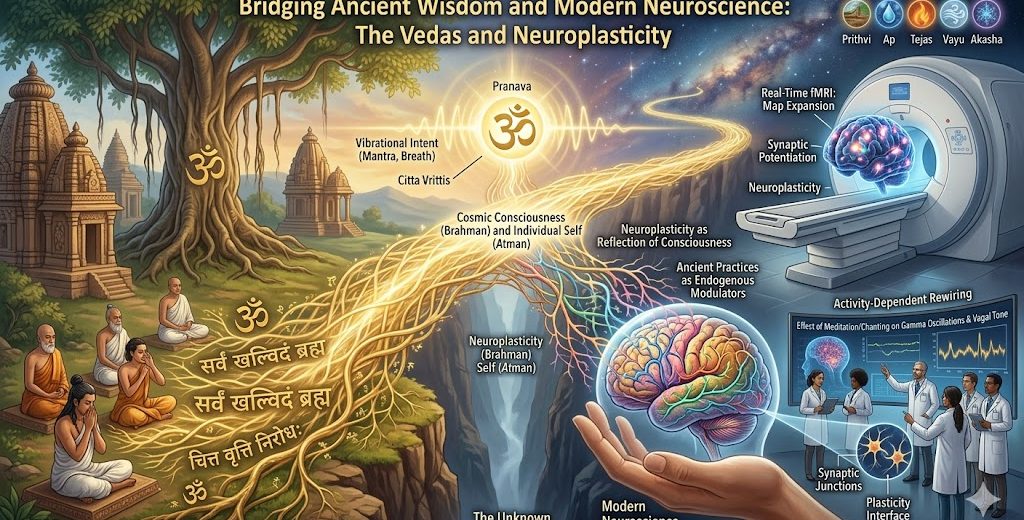
KATHMANDU — For decades, modern neuroscience operated under the assumption that the adult human brain was rigid and unchangeable. That belief changed with the discovery of neuroplasticity—the brain’s ability to reorganize itself by forming new neural connections throughout life in response to learning, experience, or mental training.
Intriguingly, this cutting-edge scientific principle directly aligns with practices codified thousands of years ago in the Vedas, the ancient sacred texts of the Indian subcontinent. Through systematic mental conditioning, phonetic chanting, and meditation, Vedic traditions essentially developed an empirical methodology for deliberate neuroplasticity long before the underlying biological mechanisms could be scanned under an MRI.
1. The Mechanisms of Neuroplasticity
At its core, neuroplasticity is driven by synaptic alterations. When neurons fire together repeatedly, they strengthen their synaptic junctions, altering both the structural anatomy and functional capacity of the brain.
Modern science categorizes this adaptability into:
- Structural Plasticity: Physical changes in the brain’s gray matter volume or the strength of axonal pathways due to prolonged learning.
- Functional Plasticity: The brain’s ability to shift specific functions from damaged areas to undamaged areas.
2. The “Sanskrit Effect”: Structural Changes via Vedic Chanting
One of the most profound intersections between the Vedas and neuroscience is found in the physical act of reciting Vedic mantras. Vedic Sanskrit is a highly structured, phonetic language where precise pitch (Svara), rhythm, and breath control are strictly mandated to maintain the integrity of the text.
A landmark study led by neuroscientist Dr. James Hartzell at the National Brain Research Centre (NBRC) in India investigated Pandits (Vedic scholars) who spend years memorizing and chanting oral scriptures. Using structural MRI scans, the research revealed a phenomenon dubbed “The Sanskrit Effect”:
- Increased Gray Matter Density: Vedic scholars exhibited significantly higher gray matter density in brain regions associated with memory, athletic coordination, and sensory processing—specifically the hippocampus and the prefrontal cortex.
- Cortical Thickening: The right hippocampus (crucial for long-term pattern recognition and memory) and the temporal vertices were physically thicker in scholars compared to control groups.
3. Meditation, Samadhi, and Functional Re-wiring
Beyond vocalizations, the Vedas—specifically within the philosophical framework of the Upanishads and Rigveda—outline states of deep meditative absorption (Dhyana and Samadhi).
Modern electroencephalogram (EEG) and fMRI studies on long-term meditators practicing Vedic or transcendental techniques reveal striking functional shifts in brain activity:
Default Mode Network (DMN) Deactivation
The DMN is the neural network responsible for the “wandering mind,” self-referential thought, and anxiety. Intensive meditative practices described in Vedic literature suppress the DMN, shifting the practitioner into a state of present-moment awareness and reducing cortisol-driven stress responses.
Gamma and Theta Wave Synchronization
Vedic meditation induces high-amplitude Gamma wave synchrony (associated with cognitive enhancement, memory integration, and heightened perception) and Theta waves (indicative of deep relaxation and creative problem-solving). This sustained neural firing fundamentally re-wires the nervous system to handle stress with greater resilience.
Comparative Matrix: Ancient Concept vs. Modern Neurobiology
| Vedic / Yogic Concept | Modern Neuroscientific Counterpart | Functional Outcome |
| Sanskara (Mental impressions / behavioral grooves) | Neural Pathways (Synaptic wiring patterns) | Repeated thoughts form physical “highways” in the brain. |
| Abhyasa (Deliberate, continuous practice) | Long-Term Potentiation (LTP) | Persistent signaling strengthens synapses, making behaviors automatic. |
| Pranayama (Breath regulation during chanting) | Vagus Nerve Stimulation & Autonomic Plasticity | Increases heart rate variability (HRV) and shifts the brain out of fight-or-flight mode. |
| Dharana / Dhyana (Fixed focus and meditation) | Prefrontal Cortex Activation | Thicker cortical layers, leading to enhanced executive function and emotional regulation. |
Peer Perspective:
The ancient Vedic rishis (seers) understood human psychology from an experiential standpoint. They recognized that the mind is not a fixed entity but a malleable instrument. By providing tools like Mantra, Japa, and Pranayama, they built a practical manual for hacking the nervous system—a manual that modern radiology and neuroscience are now validating cell by cell.
References (Sources):
- Hartzell, J. F., et al. (2016). Brains of Vedic Sanskrit Scholars Show Structural Alterations in Regions Associated with Memory. NeuroImage, Elsevier.
- Lazar, S. W., et al. (2005). Meditation experience is associated with increased cortical thickness. NeuroReport, 16(17), 1893–1897.
- National Institutes of Health (NIH). The Neurobiology of Meditation and Mindfulness Practices. NCBI PMC.
- Desai, R. (2024). Sanskara and Synapses: Exploring Behavioral Epigenetics and Neuroplasticity in Ancient Philosophy. Indian Journal of Traditional Knowledge.



Leave a Reply